Logbook Origins
From paper to digital
For decades, surgical trainees relied on paper logbooks to record operations performed during training. These records were essential for credentialing but were often cumbersome, easily lost, insecure, prone to inaccuracies, poorly validated and difficult to standardise. The limitations of paper and the emergence of electronic database software prompted the development of several specialty specific solutions in the late 1990s including Orthopaedics (Ampat & Cool), Urology (Med-IT), Neurosurgery (Thomson) and General Surgery (Carter).
Faculty of Health Informatics eLogbook
In December 2000, influenced by the Specialty Advisory Committee, Lester Sher and the late Paul Calvert established a logbook working party under the auspices of the British Orthopaedic Association (BOA) leading to a contract being put out to tender. The contract was awarded to a collaboration between a software company called Med-IT, who had pre-existing experience with the Urology logbook and the Faculty of Health Informatics (FHI) at the Royal College of Surgeons of Edinburgh (RCSEd), led by Professor Angus Wallace.
Work commenced in May 2001 but initial progress was slow. In autumn 2003 programming was brought into RCSEd with the appointment of Dr. Andrew Lamb of CleverMed Ltd. (responsible for the very successful Badgernet system) as developer, then Gareth Roberts as support developer. Development initially focused on the creation of a web-based Orthopaedic logbook. During this phase, Mike Reed was closely involved, working with the development team in the role of logbook specialty lead. This work built upon existing logbook data structures.
Once the Orthopaedic web-based eLogbook had been established, Simon Thomson assumed the role of Neurosurgical logbook specialty lead. This enabled the development team to evolve the original single-specialty logbook into a multi-specialty product by separating generic components from specialty-specific elements. As a result, a second specialty was established and an architecture capable of supporting multiple additional specialties was created. Once in place, this framework allowed other specialties to be added and integrated rapidly, leading to the development of a pan-specialty system.
Between April and June 2004 several eLogbook meetings were held leading to Neurosurgery, Maxillofacial Surgery, ENT, Urology, Plastic Surgery, Cardiothoracic Surgery and Paediatric Surgery all joining the elogbook project. [1]
By 2005 this web-based platform was multi-specialty and growing rapidly soon expanding into the Pan-Surgical eLogbook and covering all surgical specialties. In February 2007 there were 2.4 million procedures that had been recorded by 7,944 surgeons from all nine specialties [2] and by 2009, the system had over 13,000 users [3].
Intercollegiate Surgical Curriculum Programme (ISCP) and the Association of Surgeons of Great Britain and Ireland (ASGBI) logbook
The ASGBI logbook was established for general surgery in the early 2000s, with over 13,000 procedures recorded between 1st Oct 2002 and 31st Sept 2003. [4]
ISCP is the UK surgical portfolio system and was launched in 2007, the ASGBI logbook was incorporated into it and became multi-specialty [5]. For several years the ASGBI and RCSEd provided competing systems. In 2011 an intercollegiate agreement was reached, the RCSEd logbook became an intercollegiate project, funded by all three UK colleges and the Royal College of Surgeons of Ireland (RCSI), and consequently since Monday, August 15th, 2011 it has been mandatory for all surgical trainees in all specialties to use this system. The ASGBI logbook data was transitioned and the ASGBI logbook was closed [6].
Intercollegiate elogbook
By 2016 it was increasingly apparent that the elogbook needed modernisation, David Large was appointed as the elogbook clinical lead, he assembled a team and built links with the surgical community, ultimately leading to the release of a much improved version of the logbook in March 2023 [7]. Since March 2023, led by Simon Thomson, the logbook has further improved data reporting, links with ISCP and the UK surgical community.
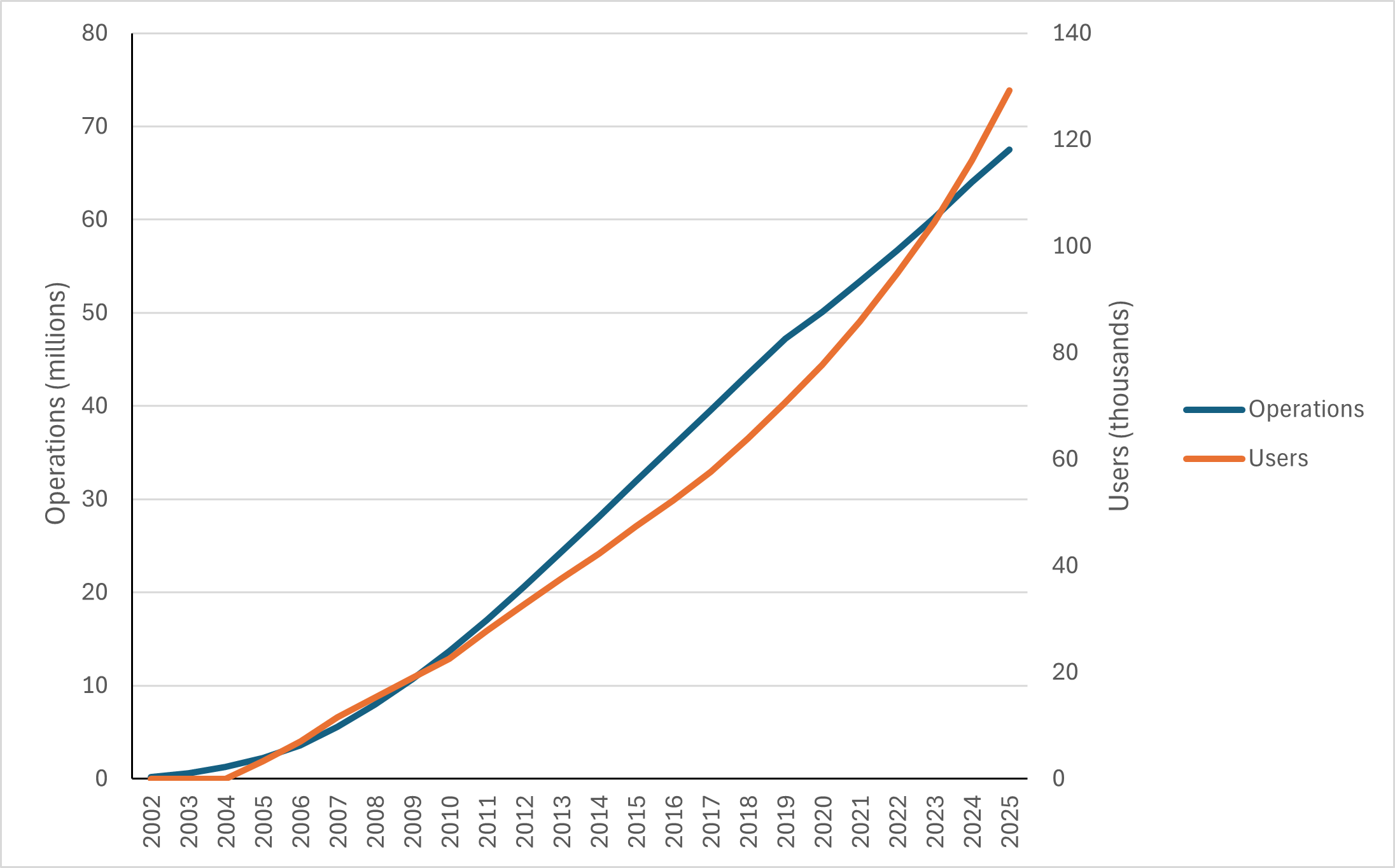
Number of users and operations recorded in the elogbook
International and specialty expansion
The elogbook is still expanding rapidly; Vascular Surgery was added in 2012, Oral Surgery (dentistry) in 2024 and other specialties are expected to follow. The system is used by large numbers of surgeons across the entire world although as a consequence of Brexit RCSI established their own logbook, eventually leaving the intercollegiate elogbook completely in 2026.
The modern intercollegiate elogbook
Today, the intercollegiate eLogbook, supports over 120,000 users in 120 countries and records over 3 million new procedures every year [8]. It underpins training, appraisals and revalidation, offering analytics for operative training experience. It seamlessly integrates into ISCP and routinely provides data that contributes to quality assurance, medical research and governance. It has become one of the cornerstones of surgical training in UK and worldwide.
References
[1] Letter from Professor Wallace to Gordon Williams JCHST chair 2nd July 2004 (unpublished).
[2] Intercollegiate eLogbook Meeting 26th March 2007 (unpublished)
[3] Ginder LM, Jones AP, Reed MR. The surgical e-logbook BMJ 2009; 338b161 doi: https://doi.org/10.1136/sbmj.b161 Feb 2009
[4] Achuthan R, Grover K, MacFie J. A critical evaluation of the electronic surgical logbook. BMC Med Educ. 2006 Mar 1;6:15. doi: 10.1186/1472-6920-6-15. PMID: 16509987; PMCID: PMC1413530.
[5] https://www.iscp.ac.uk/iscp/about-us/about-iscp/ Accessed 8/1/26
[6] ISCP News and updates Aug 2011. https://www.iscp.ac.uk/home/news_item.aspx?enc=G27SAi5avrL+jMzCMvGOqrPkRdct8n3Gy9TfP3kXfKA=#:~:text=ISCP%20Logbook%20is%20closing%20tomorrow,and%20the%20same%20guidelines%20apply. Accessed 8/1/26
[7] New Client - eLogbook | Electronic Surgical Logbook Project Mar 2023 https://www.elogbook.org/new-client Accessed 8/1/26
[8] The eLogbook and the Extended Surgical Team. FPC news, Apr 2023. Accessed 8/1/26. https://fpc.rcsed.ac.uk/fpc-news/2023/april/the-elogbook-and-the-extended-surgical-team/